Much wireless communication research in the past five years has been motivated by 6G needing the results. The 6G standardization has recently begun, so in the coming years, we will see which “6G candidate technologies” will be utilized and which will not. Research papers often focus on revolutionary new features, while technology development is often evolutionary since the demand for new features comes gradually.
Although we have yet to determine what technology components will be used, there is much certainty around things like standardization timelines, new feature categories, spectrum candidates, performance metrics, and the interplay between different stakeholders. I explain this in a new 18-minute video about 6G, where I answer what 6G truly is, why it is needed, and how it is developed.
In what ways could we improve cellular-massive-MIMO based 5G? Well, to start with, this technology is already pretty good. But coverage holes, and difficulties to send multiple streams to multi-antenna users because of insufficient channel rank, remain issues.
Perhaps the ultimate solution is distributed MIMO (also known as cell-free massive MIMO). But while this is at heart a powerful technology, installing backhaul seems dreadfully expensive, and achieving accurate phase-alignment for coherent multiuser beamforming on downlink is a difficult technical problem. Another option is RIS – but they have large form factors and require a lot of training and control overhead, and probably, in practice, some form of active filtering to make them sufficiently band-selective.
A different, radically new approach is to deploy large numbers of physically small and cheap wireless repeaters, that receive and instantaneously retransmit signals – appearing as if they were ordinary scatterers in the channel, but with amplification. Repeaters, as such, are deployed today already but only in niche use cases. Could they be deployed at scale, in swarms, within the cells? What would be required of the repeaters, and how well could a repeater-assisted cellular massive MIMO system work, compared to distributed MIMO? What are the fundamental limits of this technology?
At last, some significant new research directions for the wireless PHY community!
The PDF is available for free from the publisher’s website, and you can download the simulation code and answers to the exercises from GitHub.
I am amazed at how many people have already downloaded the PDF. However, books should ideally be read in physical format, so we have arranged a special offer for you. Until May 15, you can also buy color-printed copies of the book for only $50 (the list price is $145). To get that price, click on “Buy Book” at the publisher’s website, enter the discount code 919110, and unselect “Add Track & Trace Shipping” (the courier service costs extra).
Here is a video where I explain why we wrote the book and who it is for:
I receive many questions from students and researchers on social media, including this blog, YouTube, and ResearchGate. I do my best to answer such questions while commuting to work or having few minutes between meetings. I receive some questions quite frequently, making it worth creating videos where I try to answer them once and for all.
Below, you can find the first video in that series, and it answers the question: How many beams can you send from a MIMO array? As you will notice when watching the video, we obtain a more appropriate question if “can you send” is replaced by “do you want to send”.
If you have remaining doubts or comments after watching it, please feel free to post a comment on YouTube.
The way that mobile communication networks are designed changed dramatically with the advent of 5G. In the past, it was all about utilizing large bandwidths and deploying many base stations. Nowadays, we are instead equipping each base station and smartphone with multiple antennas, which enables us to use signal processing algorithms to improve signal strength, enhance reliability, and send more data of the same spectrum by controlling the spatial direction of each signal layer. In essence, we refine the hardware and algorithms instead of deploying more infrastructure and requiring more signal resources.
Further dramatic changes are envisioned in the 6G era, where the use of even larger antenna arrays uncovers near-field effects, conventional frequency bands will be complemented with millimeter and sub-terahertz spectrum, optimized reflections from reconfigurable surfaces might improve propagation conditions, and communication networks can provide new localization and sensing services.
These extraordinary changes will affect not only the wireless technology but also the required knowledge and skills among the engineers and researchers who will implement it. Hence, it is essential to revise the curriculum in basic wireless communication courses to shift focus onto these new aspects of the physical layer.
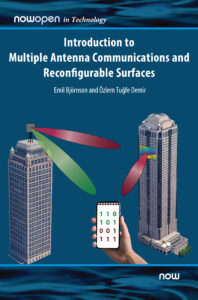
When I realized the need for a new basic textbook, I joined forces with Özlem Tuğfe Demir to write “Introduction to Multiple Antenna Communications and Reconfigurable Surfaces”, NowOpen (2024). The book provides a gentle introduction to multiple antenna communications with a focus on system modeling, channel capacity theory, algorithms, and practical implications. The reader is expected to be familiar with basic signals and systems, linear algebra, probability theory, and digital communications, but a comprehensive recap is provided in the book. Once the fundamental point-to-point and multi-user MIMO theory and its practical implications have been covered, we also demonstrate how similar methodologies are used for wireless localization, radar sensing, and optimization of reconfigurable intelligent surfaces.
The first draft of the book was written for the first-year Master course TSKS14 Multiple Antenna Communications at Linköping University. You might have seen the YouTube video series that I produced while teaching that course during the pandemic. The book covers the same things and much more, and it contains numerous new examples and exercises.
The writing process focused on pinpointing all the technical and practical know-how that we believe the next-generation wireless engineers must have within this topic. We then wrote the text as a story that leads to these points. The writing has taken a long time: four years of progressive course material development followed by two years of intense writing with the goal of completing a book.
The book is published with open access and accompanying MATLAB code that reproduces all the simulation results. You can access the PDF from the publisher’s website, where you can also buy printed copies. We are extremely proud of the book and hope you will like it too!
The golden frequencies for wireless access are in the band below 6 GHz. Why are these frequencies so valuable? The reasons, of course, are rooted in the physics. First, the wavelength is short enough that a (numerically) large array has an attractive form factor, enabling spatial multiplexing even from a single antenna panel. At the same time, the wavelength is large enough that a sufficiently large aperture can be obtained with a reasonable number of antennas – which, in turn, directly translates into a favorable link budget and high coverage. Second, below 6 GHz, Doppler is low enough, even at high mobility, that reciprocity-based beamforming based on uplink pilots for channel estimation works without relying on prior assumptions on the propagation environment, let alone on the fading statistics. This directly translates into robustness, simplicity of implementation, and scalability with respect to the number of service antennas. Third, these frequencies are not hindered so much by blockage, and strong multipath components can guarantee connectivity even when there is no line-of-sight, while in contrast, for mmWave a human blocking the line-of-sight path can suffice to break the link. Finally, analog microelectronics for the golden bands is mature, and very energy-efficient.
Distributed MIMO (D-MIMO) with reciprocity-based beamforming is the natural way of best exploiting the golden frequencies. This technology naturally operates in the [geometric] near-field of the “super-array” collectively constituted by all antenna panels together. In fact, the actual antenna deployment hardly matters at all! With reciprocity-based beamforming, the physical shape of the actual beams, and grating lobe phenomena in particular, become irrelevant. If anything, given a set of antennas, it is advantageous to spread them out over as large aperture as possible. The only definite no-no is to place antennas closer than half a wavelength together: such dense packing of antennas is almost never meaningful, as sampling points lambda/2-spaced apart captures essentially all the degrees of freedom of the field; putting the antennas closer results in coupling effects that are usually of more harm than benefit.
REINDEER is the European project that develops and demonstrates D-MIMO for the golden frequencies. What are the most important technical challenges? One is, down-to-earth, to handle the vast amounts of baseband data, and process them in real time. Another is time and phase synchronization of distributed MIMO arrays: antenna panels driven by independent local oscillators must be re-calibrated for joint reciprocity every time the oscillators have drifted apart. Locking the clocks using cabling is possible in principle, but considered very expensive to deploy. A third is initial access, covering space uniformly with system information signals, and waking up sleeping devices. A fourth is energy-efficiency, at all levels in the network. A fifth is the integration of service of energy-neutral devices that communicate via backscattering. D-MIMO naturally offers the infrastructure for that, permitting simultaneous transmission and reception from different panels in a bistatic setup; however, these activities break the TDD flow and must be carefully integrated into the workings of the system.
If sub-6 GHz are gold, then what is silver? Perhaps right above: the 7-15 GHz band, that is intended in 6G to extend the “main capacity” layer. It appears that these bands can still be suitable mobile applications, and that higher carriers (28 GHz, 38 GHz) are appropriate for fixed wireless access mostly. But the sub-6 GHz bands will remain golden and the first choice for the most challenging situations: high mobility, area coverage, and outdoor-to-indoor.