Category Archives: Commentary

Episode 50: The New Wave of Satellite Communications

Our Wireless Future podcast has reached 50 episodes! The new episode has the following abstract:

In episode fifty, Erik G. Larsson and Emil Björnson leave Earth to take a closer look at the new advancements in satellite communications. Constellations with thousands of low-Earth-orbit satellites are now orbiting the sky to deliver fast Internet connectivity to infrastructure, homes, and maybe even directly to 6G mobile phones. How can we reach such distant satellites, and how do the satellite constellations connect back to Earth? What are the intended use cases? How can the massive Doppler effect be overcome? What is the role of multi-antenna technology? All the answers are provided in this massive episode. To learn more about Distributed MIMO in space, we recommend the following paper. The Swedish SMART 6GSAT research center has the website https://cos.eecs.kth.se

You can watch the video podcast on YouTube:

You can listen to the audio-only podcast at the following places:

Teardown of a Cellular Base-Station Sector Antenna

I found a 3.5 GHz sector antenna hidden away in a box when my research division moved offices. Naturally, I had to open it up and see what was inside! In this video, I unbox the antenna and then move ahead with a teardown of it. I show what it looks like under the hood, compare that with the datasheet, and I explain how the antenna actually works. We take a look at the internal dipole array, radiation patterns, antenna gain, and how this sector antenna differs from the latest antenna designs used in 5G systems.

Episode 49: Insights from the NYU Wireless Workshop

We have released the 49th episode of the Wireless Future podcast. It has the following abstract:

The NYU Wireless Workshop this year was a lively scientific event, where the future of wireless technology was debated. Erik G. Larsson was among the invited speakers, and the main theme was “Twenty Years of Massive MIMO: What’s Next?”. In this episode, he discusses the main insights with Emil Björnson. They first dissect the practical challenges that still hinder multi-antenna technology from reaching its full potential. It ranges from unfavorable traffic patterns to channel characteristics and channel state information, and how to circumvent these issues. The conversation also covers wireless sensing, AI data aggregation over the air, near-field communications, and common misconceptions around mutual coupling. The most thought-provoking question is: Is the demand for wireless connectivity saturating, or is there still a wireless future ahead?

You can watch the video podcast on YouTube:

You can listen to the audio-only podcast at the following places:

Episode 48: Non-Uniform Antenna Arrays and Movable Antennas

We have released the 48th episode of the Wireless Future podcast. It has the following abstract:

Antenna arrays are used everywhere to enhance the wireless signal quality through beamforming and aperture gains. A common practice is to arrange antennas uniformly along a line or in a rectangle, but this is not necessarily the preferred arrangement. In this episode, Emil Björnson and Erik G. Larsson discuss how the geometry of an antenna array affects the shape of the beams it can transmit and the ability to spatially multiplex many users. They uncover how uniform arrays excel at packing many antennas into a compact space, while adjacent antennas collect redundant information about the world around us. In future systems operating above 6 GHz, we might not be able to afford to fill the aperture with antennas and can instead place them in a sparse non-uniform pattern. The vision is to optimize the arrangement at each base station site to maximize its communication and/or sensing performance. The conversation covers grating lobes, minimum redundancy arrays, preoptimized irregular arrays, and movable/fluid antenna systems. Further details can be found in “From Antenna Abundance to Antenna Intelligence in 6G Gigantic MIMO Systems”.

You can watch the video podcast on YouTube:

You can listen to the audio-only podcast at the following places:

Episode 47: Everyone Talks About Integrated Sensing and Communications

We have released the 47th episode of the Wireless Future podcast. It has the following abstract:

Almost every 6G-related keynote speech at scientific conferences focuses on ISAC: Integrated sensing and communications. In this episode, Erik G. Larsson and Emil Björnson discuss how sensing and communication technologies have been developed separately in the past but are built on similar yet distinctly different principles. The conversation covers different integration levels, beamforming implementations, fundamental tradeoffs, alternative waveforms, and the most important question: What would ISAC be used for if it becomes widely available in 6G networks? 

You can watch the video podcast on YouTube:

You can listen to the audio-only podcast at the following places:

Introduction to Integrated Sensing and Communication (ISAC)

I was recently asked to give an introduction lecture on ISAC and developed a brand new presentation for that purpose. I have now recorded a video based on that material. The lecture introduces the basic principles of ISAC, highlights similarities and differences between radar and communication systems, and discusses how and why sensing capabilities should be integrated into future cellular networks, including 6G.

The lecture covers:

  • Fundamentals of wireless sensing and communication
  • Classical radar features: range, velocity, and angle estimation
  • Comparison of radar and communication propagation models
  • Key differences between radar and communication systems
  • Levels of integration in ISAC (site, hardware, and signal sharing)
  • Potential internal and external use cases for ISAC
  • Detailed examples of range, velocity, and angle estimation
  • Trade-offs in waveform design, including the integration into OFDM systems

Reconfigurable Intelligent Surfaces are Most Attractive in mmWave Bands

The hype around reconfigurable intelligent surfaces (RIS) has escalated over the past five years. It began with communication theoretic studies based on “guesstimated” models, but gradually became more grounded through experimental validations in sub-6 GHz bands and the formation of an ETSI Industry Specification Group, which has laid the foundation for future standardization of RIS technology.

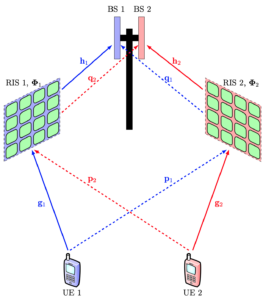
The outcomes of these efforts are mixed. On the one hand, it is clear that one can build and operate RIS roughly as envisioned. Several universities and companies have built functional RIS prototypes, and there are efficient channel estimation and beamforming algorithms for scenarios where the goal is to create a virtual line-of-sight (LOS) path around a block object (as illustrated in the figure).

On the other hand, it has become clear that practical hardware design is associated with signal losses that are often unaccounted for in theoretical studies, but limit the practical usefulness of RIS. Many actors in the telecom industry remain convinced that alternative solutions (e.g., network-controlled repeaters and small-cell base stations) are more attractive to deploy than RIS. This is aligned with my five-year-old assessment: “RIS is a hammer looking for a nail“. Since we have not yet found a practical problem that RIS can solve significantly better than other technologies, despite intensive research and pre-standardization work, I believe the RIS technology has passed the Peak of Inflated Expectations on the Gartner hype cycle curve.

I currently see the largest potential for RIS deployments in mmWave bands. This assessment is based on three observations:

  1. The propagation losses through objects grow with the carrier frequency, making it more attractive to send signals around objects than through them at mmWave frequencies compared to sub-6 GHz bands. The coverage of mmWave base stations is typically limited to LOS, e.g., a room or a street segment. Hence, a RIS could extend that coverage to a neighboring room or crossing street by creating a virtual LOS path.
  2. A RIS of a given physical size provides a larger gain at higher frequencies. The RIS collects incident signal energy proportionally to its size, so that part is frequency-independent. However, the directivity of the reflected beam (beamforming gain) increases with the carrier frequency, as more elements can be fitted into the aperture.
  3. The deployment of small-cell base stations is less attractive at higher frequencies, as coverage is limited. One RIS can replace one base station in a mmWave band, whereas multiple RISs are needed to replace one small cell at lower frequencies, as the coverage area is larger from such a base station (e.g., it could cover multiple rooms or streets).

The deployment of 5G mmWave networks is currently very limited, but once we identify the right use cases for these bands, we should also consider deploying networks using a combination of base stations and RIS.

The following video explains the fundamentals of RIS and demonstrates how effectively it can improve coverage at mmWave frequencies. The experiments were made using the XRifle Dynamic RIS and Developer Kit from TMYTEK.